Cloud Engineering vs Software Engineering
Infrastructure And Applications
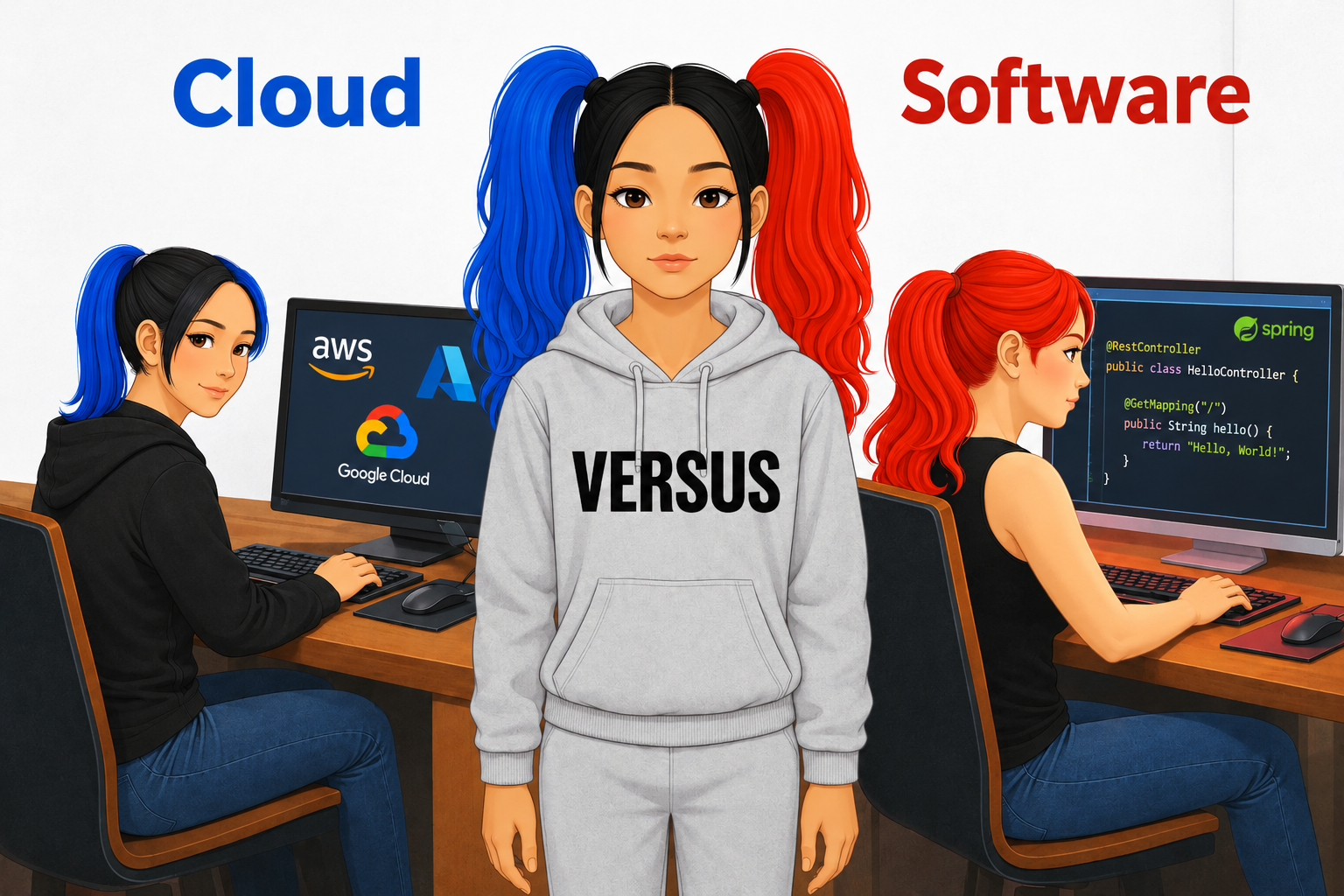
Both involve building technology solutions, solving technical problems, and working with complex systems. However, they focus on different aspects of the technology ecosystem.
Software Engineering focuses on building software. Cloud Engineering focuses on building and managing the infrastructure that runs software.
What Is Software Engineering?
Software Engineering is the discipline of designing, developing, testing, deploying, and maintaining software applications.
Software engineers use programming languages, frameworks, development methodologies, and engineering principles to create software that solves problems.
For example, a software engineer might build:
- Web applications.
- Mobile applications.
- Banking systems.
- E-commerce platforms.
- APIs and backend services.
- Artificial intelligence applications.
Common technologies used
| Category | Technologies |
|---|---|
| Programming languages | Python, Java, JavaScript, C# |
| Frontend development | React, Angular, Vue.js |
| Backend development | Spring Boot, Django, Node.js |
| Databases | PostgreSQL, MySQL, MongoDB |
| Version control | Git, GitHub |
| Testing | JUnit, Selenium, PyTest |
Example: Software Engineering
Imagine building an online banking application.
A software engineer might develop:
- User registration and authentication.
- Account management functionality.
- Money transfer functionality.
- Transaction history.
- API integrations.
- Application security and validation.
The primary responsibility is ensuring that the application works correctly, securely, and reliably.
What Is Cloud Engineering?
Cloud Engineering focuses on designing, building, deploying, automating, and maintaining infrastructure and services in cloud computing environments.
Cloud engineers work with cloud platforms to provide the computing resources, networking, storage, security, and operational capabilities that applications need.
For example, a cloud engineer might build:
- Cloud infrastructure.
- Virtual machines and container environments.
- Virtual networks and connectivity.
- Storage solutions.
- Database infrastructure.
- CI/CD pipelines.
- Monitoring and observability solutions.
Common technologies used
| Category | Technologies |
|---|---|
| Cloud providers | AWS, Microsoft Azure, Google Cloud |
| Infrastructure as Code | Terraform, CloudFormation |
| Containers | Docker, Kubernetes |
| Configuration management | Ansible |
| CI/CD | GitHub Actions, Jenkins |
| Monitoring | CloudWatch, Prometheus, Grafana |
| Operating systems | Linux, Windows Server |
| Networking | DNS, TCP/IP, VPNs, load balancing |
Example: Cloud Engineering
Using the same online banking application, a cloud engineer might be responsible for:
- Provisioning the cloud infrastructure.
- Configuring virtual networks.
- Deploying application servers.
- Setting up databases and storage.
- Implementing security controls.
- Configuring load balancing and auto-scaling.
- Monitoring application availability and performance.
The primary responsibility is ensuring that the environment supporting the application is secure, available, scalable, and reliable.
Cloud Engineering vs Software Engineering
| Feature | Cloud Engineering | Software Engineering |
|---|---|---|
| Primary focus | Cloud infrastructure and services | Software applications |
| Main responsibility | Build and manage environments | Design and build software |
| Programming | Python, Bash, PowerShell | Python, Java, JavaScript, C# |
| Infrastructure | Core responsibility | Usually consumes infrastructure |
| Architecture | Cloud and infrastructure architecture | Application and software architecture |
| Automation | Infrastructure and operational automation | Development and testing automation |
| Deployment | Infrastructure and application deployment | Application deployment |
| Common tools | Terraform, Ansible, Kubernetes | Git, IDEs, frameworks, testing tools |
| Performance focus | Infrastructure performance and availability | Application performance and responsiveness |
An Analogy: Building a House
Imagine you're building a house.
Software Engineering is like designing and building the house itself.
It involves designing the rooms, determining how everything should function, selecting materials, and ensuring that the house meets the requirements of its occupants.
Cloud Engineering is like establishing the environment and utilities that make the house operational.
It involves providing electricity, water, security systems, connectivity, and the infrastructure that allows the house to function.
Both disciplines are necessary for delivering a complete solution.
Do Cloud Engineers Need to Know Software Engineering?
Absolutely!
Cloud Engineering and Software Engineering increasingly overlap, particularly in modern DevOps and cloud-native environments.
Cloud engineers benefit from understanding:
- Programming fundamentals.
- APIs and application architecture.
- Git and version control.
- Data structures and scripting.
- Software deployment processes.
- Testing and debugging.
Similarly, software engineers benefit from understanding:
- Cloud computing fundamentals.
- Networking.
- Containers.
- Infrastructure as Code.
- CI/CD.
- Monitoring and observability.
You don't necessarily need to become an expert in both disciplines, but understanding how they complement each other makes collaboration much easier.
What About DevOps Engineering?
DevOps sits at the intersection of software development and IT operations.
It promotes collaboration, automation, continuous integration, continuous delivery, and reliable software releases.
A DevOps engineer often works with both software development and cloud infrastructure.
For example:
- Software engineers write application code.
- Developers push code to a Git repository.
- CI/CD pipelines automate testing and builds.
- Container images are created.
- Infrastructure and deployment configurations are applied.
- Applications are deployed to cloud environments.
- Monitoring tools track application and infrastructure health.
This is where Cloud Engineering and Software Engineering come together.
Which Career Should You Choose?
It depends on the type of problems you enjoy solving.
Choose Cloud Engineering if you're interested in:
- Cloud computing and architecture.
- Infrastructure automation.
- Networking and security.
- Linux and operating systems.
- Containers and Kubernetes.
- DevOps and platform engineering.
- Scalability, availability, and reliability.
Choose Software Engineering if you're interested in:
- Building applications.
- Programming and problem-solving.
- Application architecture.
- Backend and frontend development.
- Algorithms and data structures.
- Software testing.
- Designing products and features.
Neither career is inherently better. They offer different opportunities and require different areas of specialization.
In Conclusion
Cloud Engineering and Software Engineering are complementary disciplines within the technology industry.
- Software Engineering: Build the applications.
- Cloud Engineering: Build the environments that run the applications.
One focuses primarily on the software; the other focuses primarily on the infrastructure.
However, modern engineering increasingly requires an understanding of both.
As applications become more distributed, cloud-native, automated, and dependent on AI, the boundaries between these disciplines continue to evolve.
Software makes technology useful. Cloud makes technology scalable and accessible.
Both are essential to building modern digital solutions.
About the author
I am a Cloud Engineer and a Writer.
Comments
Join the discussionNo comments yet. Be the first to comment.