Python vs Java
Simple And Robust
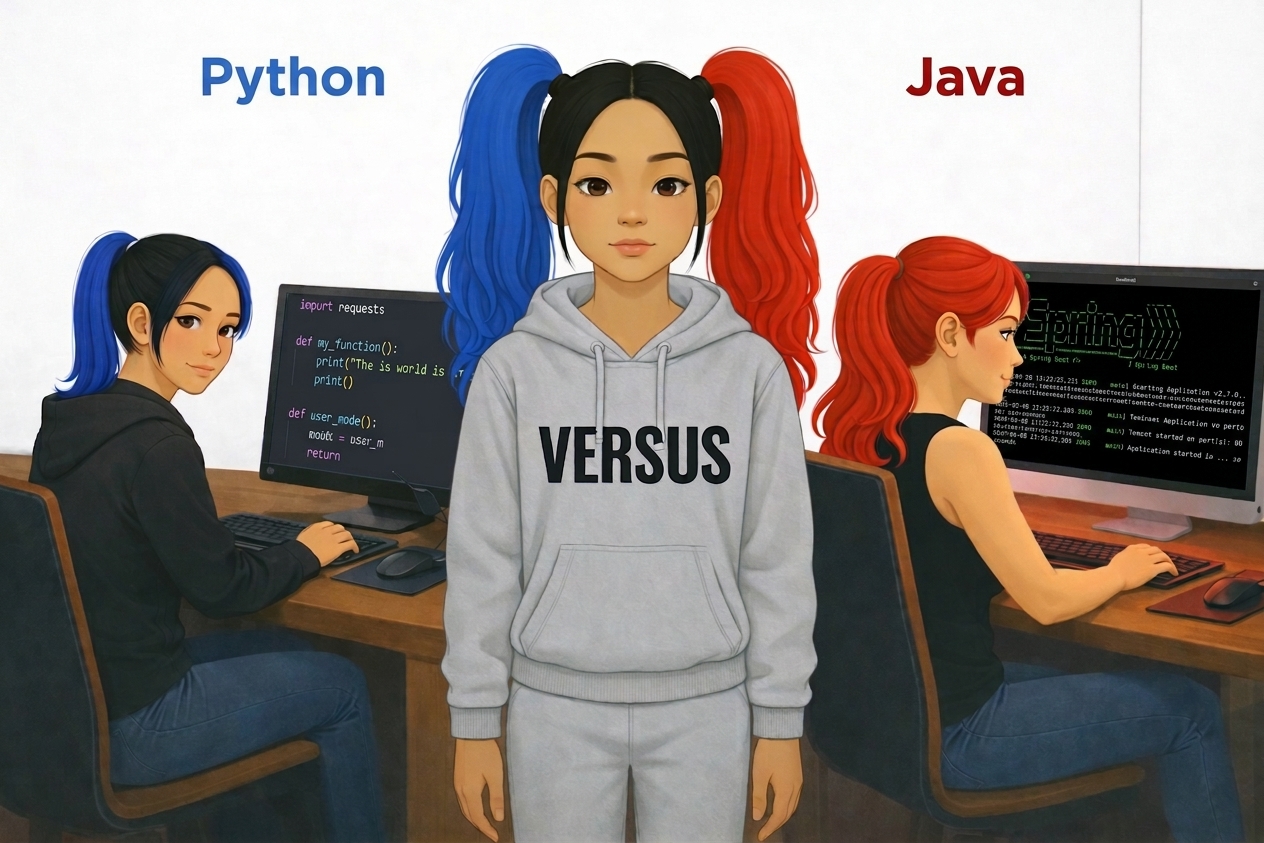
Python and Java.
Both can be used to build applications, automate tasks, work with data, and develop backend systems. However, they differ in syntax, execution, and the types of projects they're commonly used for.
Python prioritizes simplicity and readability. Java emphasizes structure, portability, and robust application development.
What Is Python?
Python is a high-level, general-purpose programming language known for its readable syntax and extensive ecosystem of libraries.
For example, printing a message in Python requires just one line:
print("Hello, World!")
Python is commonly used for:
- Artificial Intelligence and Machine Learning
- Data Science and Data Analysis
- Automation and Scripting
- Web Development
- Cloud Engineering and DevOps
Its relatively concise syntax makes it approachable for beginners and productive for experienced developers.
What Is Java?
Java is a general-purpose, class-based programming language designed around object-oriented programming and portability.
The equivalent Java program is:
public class Main {
    public static void main(String[] args) {
        System.out.println("Hello, World!");
    }
}
Java requires more structure for this simple example, but that structure supports conventions used in large applications.
Java is commonly used for:
- Enterprise Backend Systems
- Banking and Financial Applications
- Android Development
- Large-scale business applications
- Distributed Systems and Cloud services
Java code typically compiles to bytecode that runs on the Java Virtual Machine (JVM), helping applications run across different operating systems when a compatible JVM is available.
Python vs Java
| Feature | Python | Java |
|---|---|---|
| Syntax | Concise and readable | More explicit and structured |
| Typing | Dynamically typed by default | Statically typed |
| Execution | Commonly interpreted by a Python implementation | Compiled to JVM bytecode and executed by the JVM |
| Performance | Often slower for CPU-bound pure-language code | Often faster for CPU-intensive workloads after JVM optimization |
| Learning Curve | Generally beginner-friendly | More concepts and structure to learn initially |
| AI and Data Science | Extensive ecosystem | Available, but less dominant |
| Enterprise Applications | Widely used | Widely used |
| Memory Management | Automatic | Automatic |
| Common Frameworks | Django, Flask, FastAPI | Spring Boot, Jakarta EE |
Performance depends on the implementation, workload, libraries, and runtime configuration. Not just the language.
The Same Task, Two Languages
Suppose you want to calculate the sum of numbers from 1 to 5.
Python
numbers = [1, 2, 3, 4, 5]
print(sum(numbers))
Output: 15
Java
public class Main {
    public static void main(String[] args) {
        int[] numbers = {1, 2, 3, 4, 5};
        int sum = 0;

        for (int number : numbers) {
            sum += number;
        }

        System.out.println(sum);
    }
}
Output: 15
Both solve the same problem. Python uses a built-in function to keep the code short, while Java demonstrates explicit types and a loop.
Which One Should You Learn?
Choose Python if you're interested in:
- AI and machine learning
- Data engineering and analytics
- Automation and scripting
- Rapid prototyping
- Cloud and DevOps tooling
Choose Java if you're interested in:
- Enterprise software engineering
- Backend development with Spring Boot
- Large-scale business systems
- JVM-based distributed applications
- Android development, alongside its other languages and tools
Neither language is limited to these areas. Python can power production systems, and Java can be used for data processing and machine learning.
In Conclusion
Python and Java are both valuable programming languages, but they offer different development experiences.
- Python: Write less code to express an idea.
- Java: Build with explicit types and structured conventions.
If you're unsure which to learn first, choose based on the projects you want to build. Python is an excellent starting point for AI, automation, and data work. Java is an excellent choice for structured backend and enterprise development.
Ultimately, learning programming concepts matters more than choosing the “perfect” first language. Once you understand variables, loops, functions, data structures, and object-oriented programming, learning another language becomes much easier.
About the author
I am a Cloud Engineer and a Writer.
Comments
Join the discussionNo comments yet. Be the first to comment.