JavaScript vs Java
Web Development And Enterprise Engineering
JavaScript is not Java, and Java is not JavaScript.
Despite sharing part of their names, they are two different programming languages with different origins, characteristics, and use cases.
Both are widely used in software development, but they are not interchangeable.
JavaScript brings interactivity to the web. Java powers applications ranging from enterprise systems to backend services.
What Is JavaScript?
JavaScript is a high-level, dynamically typed programming language primarily known for making websites interactive.
HTML provides the structure of a webpage, CSS controls its presentation, and JavaScript adds behaviour and functionality.
For example, JavaScript allows you to:
- Respond to button clicks.
- Validate forms.
- Update webpage content dynamically.
- Create interactive user interfaces.
- Communicate with backend APIs.
- Build web servers and backend applications.
JavaScript is commonly used for:
- Frontend web development.
- Backend development using Node.js.
- Full-stack application development.
- Mobile application development.
- Browser-based games.
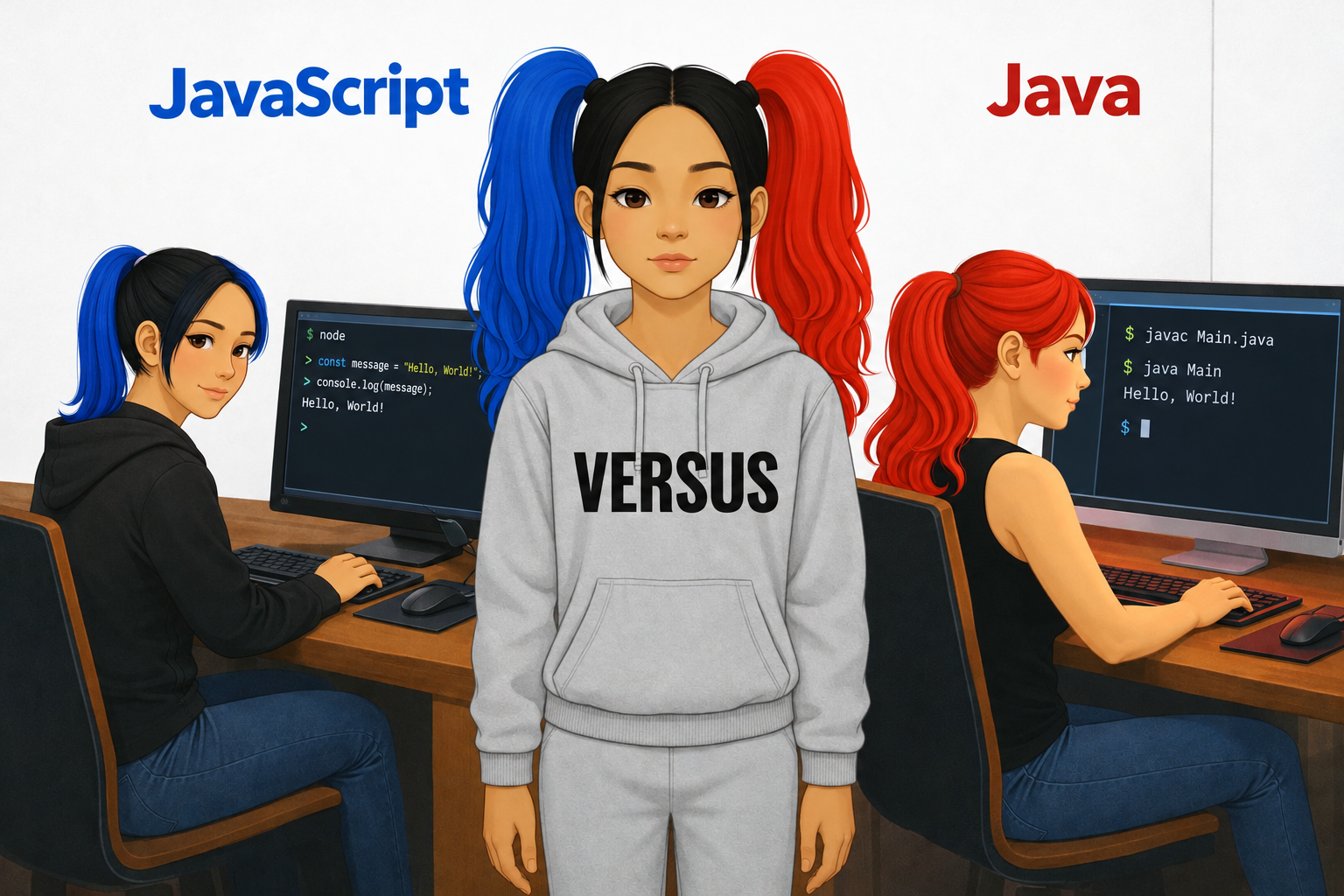
Example: JavaScript
const message = "Hello, World!";

console.log(message);
JavaScript is particularly popular because it runs natively in modern web browsers.
What Is Java?
Java is a high-level, class-based, statically typed programming language widely used for building enterprise applications, backend systems, and distributed applications.
Java follows an object-oriented programming approach and uses the Java Virtual Machine (JVM) to execute compiled bytecode.
Java is commonly used for:
- Enterprise application development.
- Banking and financial systems.
- Backend development.
- Android development.
- Distributed systems.
- Cloud applications.
Example: Java
public class Main {
    public static void main(String[] args) {
        String message = "Hello, World!";

        System.out.println(message);
    }
}
Java requires more explicit structure than JavaScript, particularly when defining classes, methods, and data types.
JavaScript vs Java
Although their names are similar, their technical characteristics differ.
| Feature | JavaScript | Java |
|---|---|---|
| Typing | Dynamically typed | Statically typed |
| Programming Paradigm | Multi-paradigm | Primarily object-oriented |
| Execution | Browser engines or JavaScript runtimes | Java Virtual Machine (JVM) |
| Compilation | Commonly interpreted and JIT-compiled | Compiled to JVM bytecode |
| Syntax | Generally concise and flexible | More explicit and structured |
| Primary Environment | Web browsers and Node.js | JVM-based environments |
| Frontend Development | Widely used | Not commonly used |
| Backend Development | Node.js | Spring Boot, Jakarta EE |
| Common Frameworks | React, Angular, Vue.js, Express | Spring Boot, Jakarta EE |
| File Extension | .js |
.java |
The Same Task, Two Languages
Let's look at how both languages perform the same task.
Suppose you want to create a function that adds two numbers.
JavaScript
function addNumbers(a, b) {
    return a + b;
}

console.log(addNumbers(5, 10));
Output:
15
Java
public class Main {

    public static int addNumbers(int a, int b) {
        return a + b;
    }

    public static void main(String[] args) {
        System.out.println(addNumbers(5, 10));
    }
}
Output:
15
Both produce the same result, but Java requires explicit type declarations and a class structure.
Then Why Do They Have Similar Names?
This is probably one of the most confusing aspects for beginners.
JavaScript was originally called Mocha and later LiveScript before being renamed JavaScript in 1995.
The name was partly influenced by the popularity of Java at the time.
However, JavaScript was not created as a version of Java.
They developed independently and have different language designs, execution environments, and ecosystems.
JavaScript is not Java, and Java is not JavaScript.
The similarity in their names should not be mistaken for technical similarity.
Which One Should You Learn?
It depends on what you want to build.
Choose JavaScript if you're interested in:
- Frontend web development.
- Building interactive websites.
- Full-stack development.
- React, Angular, or Vue.js.
- Backend development with Node.js.
- Browser-based applications.
Choose Java if you're interested in:
- Enterprise software engineering.
- Backend development with Spring Boot.
- Banking and financial applications.
- Large-scale distributed systems.
- JVM-based application development.
- Android development.
Both languages also have applications beyond these areas.
Can You Learn Both?
Absolutely!
Learning JavaScript and Java can give you exposure to different programming concepts and development environments.
For example:
- JavaScript introduces you to dynamic typing, asynchronous programming, and event-driven development.
- Java introduces you to static typing, object-oriented programming, and JVM-based application development.
Understanding both can make you a more versatile software developer.
In Conclusion
JavaScript and Java share a name, but they serve different purposes in the software development ecosystem.
- JavaScript: Build interactive web experiences and applications.
- Java: Build structured, scalable applications that run on the JVM.
If you're interested in web development, JavaScript is an excellent starting point.
If you're interested in enterprise software and backend engineering, Java is worth exploring.
And remember:
JavaScript ≠ Java.
Two languages.
Two ecosystems.
Two very different development experiences.
About the author
I am a Cloud Engineer and a Writer.
Comments
Join the discussionNo comments yet. Be the first to comment.